Support Topic Category: COPD
Support topics – for COPD
 Listed on the left are the main topics carers told us they want to know more about.
Within each you can see, hear and read advice from experts, carers and patients.
To access this advice, click on the button for the topic you are interested in.
Accessing care and support – COPD
Knowing how to get the right kind of support for you and the patient is important. Particularly if the patient’s illness starts to get more difficult to manage and you need more medical help, sometimes urgently. There can be many different people involved in the patient’s care, and it can be difficult to know who to ask for help and when.
The importance of being a ‘carer’
Other carers have told us that taking on the label of ‘carer’ can help get access to the right support. Make sure the healthcare team know that you are the person supporting the patient and the key role you have in this. This can help you get the support and information you both need.
If you are not keen on the word ‘carer’, try and think of it as a ‘magic word’ to help you and the patient get support.
It can help to think of the label of ‘carer’ as the key that opens doors to help and support for you and the patient.
Who might be on the healthcare team?
It can be difficult to know what each healthcare professional does, and how they can help. Below is a list of people that may be providing care for the patient, and what they do. If you are ever unsure about what a healthcare professional does or (what their role is) they will be happy to tell you if you ask. Knowing how your care team works will help you and the patient understand who can help and when.
In COPD care it is common to have several different specialists as part of the healthcare team – some common types of healthcare professionals who might be involved include:
- GP / family doctor
- Respiratory consultant – a doctor who specialises in diagnosing and treating people with lung diseases
- Physiotherapists
- Specialist respiratory nurses
- Lung function technicians – specialist technicians who run tests to diagnose lung diseases
- Palliative care team – doctors, nurses, pharmacists, and other health care professionals who work together to manage symptoms, such as breathlessness, pain, or fatigue
Visit the COPD.net to read more about what COPD healthcare professionals do.
Levels of care in the UK
It can be tricky to understand how healthcare is provided in the UK. If you are ever unsure about what someone means when they use any terms to explain the patient’s care, just ask and they will be happy to explain what they mean to you.
- ‘Primary care’ is a term used to describe the first point of contact for people in need of healthcare – this can include the GP surgery, dentists and pharmacists
- ‘Secondary care’ is usually hospital care – either planned care (like outpatient appointments) or urgent medical care (like going to Accident and Emergency)
- ‘Tertiary care’ is highly specialised, consultative treatment usually for inpatients (hospital or hospice) or on referral
- ‘Acute care’ usually means hospital care such as Accident and Emergency, inpatient, outpatient medicine and surgery and specialist medical care – most inpatient stays under ‘acute care’ are for a short time
- ‘Long-term care’ is usually given to people who have serious, ongoing health problems – it usually involves a variety of different services often delivered in the home or in a care home
What is palliative care?
Palliative care is not just for people close to death.
Some people might get palliative care for weeks, months or even years before the end of life. Palliative care helps make sure patients are as comfortable as possible, by managing the symptoms of illnesses that can’t be cured. It is an approach in which the whole person is cared for, not just their symptoms.
Some carers and patients misunderstand what palliative care is and can feel taken aback when their healthcare team suggest a referral to a palliative service, thinking the patient is about to die. Talking to a palliative care team early on can help guide you both in later treatment decisions.
Helpful tip
During emergencies, you may be asked to repeat details of the patient’s medical story (their medical and care history) to each healthcare team that you meet e.g. ambulance services, emergency department teams. This can cause you and the patient additional stress.
It can be helpful (if the patient agrees) to have key notes about the patient’s medical story already written down to share with the healthcare teams.
You may find using the ‘Medical story’ template below helpful for this. There are two versions – a Word version in case you want to download and type in the story, and a PDF version in case you want to print it off and write in the story by hand. You don’t have to use them – they are just there for you in case they are useful. The Supporting Someone with Breathlessness website will not be able to see or keep any information you put on these templates.
Click here for a printable version of this page (PDF, 425KB)
Would you like to look at another support topic?
Page last reviewed: 15/12/2025
As the patient becomes more unwell – COPD
Symptoms can change for people living with breathlessness – they can become more difficult to manage. Some carers have found it helpful to know what to expect, so that they can feel more prepared.
What to expect
It is likely that patients’ symptoms will get more intense at some stage. They may need more medical appointments, hospital visits or treatments, as well as support from others for daily living.
‘Expect more trips to the hospital and know that you are certainly not failing’
– ‘Phil’, former carer for his mother
– ‘Phil’, former carer for his mother
It isn’t possible to put a timeframe on how someone’s symptoms may change in the later stages of living with COPD. For some, symptoms may gradually get worse over a number of weeks, months or even years until the patient dies. For others, they may go through several ups and downs where their symptoms suddenly get worse (often requiring urgent medical help), then become a little better again. This can be a particularly upsetting time for these patients and their carers, particularly if the COPD has been under control for a while. For some people, these ups and downs with symptoms can become a pattern until the patient doesn’t improve, and dies. Carers can also find it difficult to adjust to times when things are much calmer, and there is less for them to do.
‘‘We couldn’t believe it when the phone rang and they told us he’d died. You know, it was like “this can’t be true”. You know, “he’s been like this so long”’
– ‘Lisa’, former carer for her father
– ‘Lisa’, former carer for her father
Sudden changes can sometimes happen in COPD patients’ symptoms. It may be that at some point the patient is not able to say for themselves what they want to happen, so it’s important to have talked together, ahead of time, about what to do about future treatment decisions. For example, it might help to talk about whether they would like to have an Advance Directive or an Advance Decision to Refuse Treatment. The Macmillan website has more information about what these are – although the Macmillan website refers to cancer, this information is relevant to COPD too.
Learn what ‘Advance decision to refuse treatment orders’ are and why it’s important that carers and patients make arrangements to have one
Common symptom changes
When caring for someone with breathlessness due to COPD, there are some general changes in symptoms to look out for as their illness progresses. This is not a complete list, and how each patient’s symptoms change will be unique to them. You will be better able to judge whether the patient’s symptoms are changing if you have a clear idea of what is a normal baseline level for them. Whenever you have any concerns or questions talk to your healthcare team – they are best placed to give you advice about the person you care for.
You might notice:
- more breathlessness
- wheezing – usually a higher pitched noisy breathing
- chest tightness
- a need to clear the lungs of mucus everyday
- a lack of energy a loss of appetite and weight loss
- more infections and flare ups. You can learn more about managing infections here.
Hear from healthcare professionals, what symptoms to expect as a patient with COPD becomes more unwell and ideas for how to manage them
What you can do to help the patient
Talk to your healthcare team (e.g. district nurse, specialist nurse or GP) if you find it difficult to manage any symptoms the patient has. They may recommend the patient has a short respite stay. Look at the Macmillan website for helpful advice on how you can manage some of the difficult symptoms patients can have towards the end of their illness at home. The Macmillan website has a range of information helpful for all kinds of long-term illnesses including COPD.
Impact on emotional health
It’s common for carers to feel drained, both physically and emotionally, as the patient’s symptoms worsen and they rely on you for even more support. You may feel you have very little time for yourself. At times like these, it is especially important to try to look after your own health and well-being even though you may feel reluctant or unsure about doing so.
What you can do to help the patient
More often than not the patient will also be struggling with difficult emotions as symptoms change. Some patients may start to withdraw from their normal daily life. Encouraging the patient to talk honestly about their feelings can help. This could be by talking with you, with other family members or friends or with a trained professional like a nurse or counsellor.
‘I don’t think my mum had ever really told me how she was struggling. She would always try and put a brave face on it’ – ‘Greg’, former carer for his mother
Click here for a printable version of this page (PDF, 622KB)
Would you like to look at another support topic?
Page last reviewed: 15/12/2025
Pacing
Pacing is about:
- trying not to rush things or do too much at once – these can tire you both out, making you both feel worse in the long run
- creating a balance between being active and resting
This sounds simple, but there are a couple of ‘traps’ that carers and patients can fall into which can lead to problems later on:
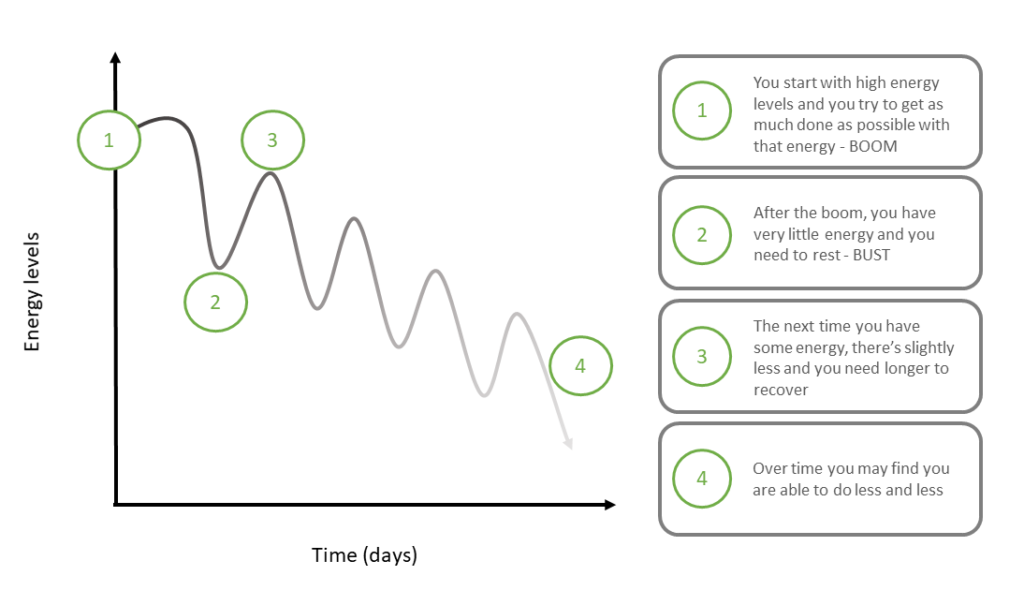
Trap 1: Boom and bust
Boom and bust is a common cycle that people with health problems can find themselves in. The diagram below explains why this cycle can be a problem:
Trap 2: Resting too much
Energy levels can be unpredictable for people with breathlessness.
It can seem hard to tell which activities will make them tired and which won’t.
For patients it can be tempting not to do anything much at all and just rest. Sometimes carers also take over and do everything for the patient.
Too much rest without activity is actually unhelpful, as it can mean losing fitness and muscle which cause people to feel even more tired.
What you can do to help the patient
- To avoid a boom and bust, where you might do a lot on one day and then rest for several days following, try to keep the amount of activity you and the patient do stable. Think about doing as much on a lower energy day as you do on a higher energy day.
- Try to break down big or long jobs into smaller or shorter tasks with regular breaks in between.
- While it can feel frustrating, and may take longer to do things this way, the patient should have more energy afterwards and avoid the ‘bust’ part of the cycle.
- It’s also important to encourage the patient to do things for themselves. Not enough activity can lead to longer term problems as their muscles weaken and they may lose fitness.
For more ideas of ways to keep active with the patient see Keeping active.
In the video below, carers and patients discuss how they use pacing to manage their activities with breathlessness
Would you like to look at another support topic?
Page last reviewed: 15/12/2025
Permission
Supporting people with breathlessness to live a fulfilling life, and to do everything you need to get done, can be challenging.
Carers and patients can put a lot of pressure on themselves to do things in the same way as other people or to do things in the way they did before the patient had breathlessness. Because of this, it is common for carers and patients living with breathlessness to feel frustrated at times.
In reality, everyone’s experience of breathlessness is different and everyone is able to do different amounts.
What you can do to help the patient
- Giving yourself and the patient permission to do things in a new way – your own unique way – can help take off some of this pressure
- Giving yourself permission to do things differently can also help you do the other 5 Ps
- It’s also important to give yourself permission to look after your own health
- Focus on what you and the patient are able to do, rather than on what you can no longer do
- Try to be patient with one another and talk to each other if you are feeling upset. More often than not, if you are finding something difficult, the patient will be struggling with it too.
Would you like to look at another support topic?
Page last reviewed: 15/12/2025
Problem solving
Problems will arise and plans are likely to need to change when you are living with breathlessness – even with the best prioritising and planning.
Being able to problem-solve together to overcome these problems will help get you both back on track.
There are lots of activities you can do together, and some might even help the patient’s breathlessness.
Steps for problem-solving together – Ask yourselves ‘what is the problem?’ Does it help to break it down into smaller pieces? – Ask yourselves ‘what might help solve this problem?’ Can someone else help or give advice? Try to think of solutions with the patient that meet both of your needs. – Decide which solution is best. It can help to think of the pros and cons of each. Listen to the patient’s concerns. The solution: contact the doctor to see if a phone consultation or home visit can be arranged.Have you tried...?
Sarah needs to see the doctor for a new prescription but she can’t travel as she is too breathless
Rebook Sarah’s appointment for the next day?
Phone the pharmacy/GP for advice?
Could the doctor do a phone consultation or home visit instead?
Rebook Sarah’s appointment for the next day? Cons: she feels she can’t wait that long
Phone the pharmacy/GP for advice? Cons: she may need more specialist advice, or they can’t give a prescription.
Could the doctor do a phone consultation or home visit instead? Pros: She doesn’t need to travel and the doctor can give her specialist advice and a prescription.
In the video below, carers talk about how they problem-solve together, with the patient, to overcome the challenges of breathlessness
Would you like to look at another support topic?
Page last reviewed: 15/12/2025
Prioritising
When you are caring for a patient who has limited energy, it is important to try and prioritise. Prioritising means deciding which jobs are most important and getting them done first. To help with this:
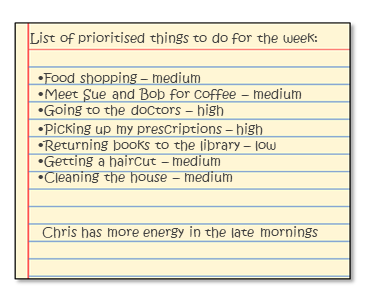
- Try writing down together, a list of everything you and the patient need to do in the next week. You’ll need to work around appointments and events that can’t be changed.
- Then decide together which are ‘high’, ‘medium’ and ‘low’ priority.
Have you tried...?
It can help to ask yourselves these questions
- Is this activity essential?
- Can it wait?
- Could someone else do it instead?
- Does it energize the patient? Does it revitalize them, or does it drain their energy away? E.g. seeing friends, watching a favourite film, or doing a hobby the patient enjoys
Ideas for how to decide which priority to give different activities:
Something like going to the doctors is high priority as it is essential to the patient’s health – it shouldn’t wait, it couldn’t be done by someone else and is energizing.
Returning books to the library would be low priority as it is not essential – it can wait, someone else could do it instead, and it doesn’t really energize the patient.
- Try to prioritise activities which are energizing and put those that are energy-draining lower down the list
- Try to think about times when the patient tends to have more energy and plan high priority activities for those times
- You may not get around to doing the low priority tasks, or it may be someone else does them for you instead. That is just fine because people do like to help. Give yourself permission to accept help from others.
- Once you have prioritised tasks, and agreed when the patient is most likely to be able to do them, you can start planning tasks for specific days
Would you like to look at another support topic?
Page last reviewed: 15/12/2025
Planning
Making plans can help but they can be hard to stick to when you are caring for someone. Breathlessness can be unpredictable.
- Planning ahead can help save precious energy
- Plan tasks for specific days, after you have prioritised the jobs you need to complete for the week.
- Try to space activities across the week to avoid doing things all in one day, or a few days close together
- You’ll need to work around appointments or events that can’t be changed. Try to book appointments for the time of day when the patient tends to have more energy, allowing time for getting ready and travel.
- Be flexible and try not to be too hard on yourselves if you need to change your plans. You may need to check and change your weekly plan several times during a week.
In the video below hear from carers and patients how they use planning to get important jobs done
“I’ve found it very difficult putting away – like doing a gardening job and then you’ve got to roll up the wires, the cable, and bring the wheelbarrow back, and it’s that last bit, “I don’t want to do that bit,” but you’ve got to do it because it’s got to go away in case it rains. And that is the bit that really does knacker you. I’ve learnt to put my tools in a bucket so all I’ve got to do is pick that up” – ‘Stuart’, person with breathlessness
Would you like to look at another support topic?
Page last reviewed: 15/12/2025
Understanding Breathlessness
This is the only section with two landing pages?
Add two boxes linking to either Understanding Breathlessness Cancer or Understanding Breathlessness COPD
Cancer + COPD specific content:
Also if this is of any help we were thinking of our site having functionality like this homepage – click on the ‘journey’ (e.g “ I have COPD” or “I have asthma”) that is relevant to you and only see content relevant to that journey: