Looking after your own health


It’s incredibly important to look after yourself, especially when you’re caring for someone else – you’ve probably been told this many times before. It’s one of those things that sounds simple but can actually be quite hard to do.

Carers have told us that they don’t often take time for themselves. Sometimes this is because they don’t know how to care for themselves, feel like they simply don’t have the time or are worried that the patient won’t cope without them.

Some carers worry that taking time for themselves can seem selfish but we know that making sure you’re rested and well will mean you are able to give the best possible care to the patient

What you can do to help yourself

Give yourself permission to look after yourself – it's not being selfish, it's being responsible

  • Being social and meeting other people – local support groups are a great way for both you and the patient to have some social time meeting and connecting with others
  • Have a coffee or go for a walk outside while the patient has their health appointments
  • Ask for help – people want to help, so ask others to be with the patient from time to time so you can take time for yourself
  • Taking small snatches of time for yourself can help – like even a 5 minute walk around the block or a short relaxation exercise
  • Find out about carer benefits and allowances – there may be some benefits and allowances you are entitled to as a carer of someone with breathlessness. See ‘Accessing allowances and benefits for carers‘ below for more information.

In this video, carers talk about the importance of giving themselves permission to take time for themselves

Hear from a patient and from a former Community Matron and District Nurse, Sophie Howson, why it’s so important that carers look after their own health


Accessing allowances and benefits for carers

In the UK, there are several benefits and allowances that you may be entitled to as the carer of someone with breathlessness. By taking on the title of ‘carer’ and having a ‘Carer’s Assessment’ done by your local authority, you can find out what type of benefits, allowances and general support you may be entitled to. Carers UK has useful information about which benefits you might be entitled to.

Click here for a printable version of this page (PDF, 404KB)

Would you like to look at another support topic?

Page last reviewed: 15/12/2025

Talking about the future with others


Talking about the future with the patient, with other family, and with friends, can help people feel more prepared for what might happen. Not everyone is open to talking about the future and having these conversations is not always easy.

In the video below, carers and a patient discuss the importance of carers and patients talking about the future together

In the video below, healthcare professionals talk about the benefits to carers and patients of talking about the future together


Would you like to look at another support topic?

Page last reviewed: 15/12/2025

When someone is close to dying


What is it like when someone is close to dying?

For some people dying can be a gentle series of physical changes which are not medical emergencies. For others it can be quicker, and this can be unexpected both by patients and by carers. In both situations, when someone is close to dying, major organs slow down and the body begins to close down.

No one can say exactly what it will be like when someone dies. What we do know, is that the patient’s healthcare team will do their best to make sure the patient is as comfortable as possible.


What you might like to think about

It can be reassuring for patients and carers to talk together about dying and understand what they each think might happen. If there is anything that seems unclear to either of you about dying, ask your healthcare team.

It can be helpful to ask the patient where they would like to be at that time and for them to be able to express any concerns or wishes. This can provide a sense of control, which can be reassuring. For example, the patient may want to be at home, in hospital or in a hospice – and be aware that their thoughts on this may change over time. If the patient is happy for you to do so, it can be helpful to share their thoughts with the healthcare team.

“In hindsight, I wish I’d have known it was coming because we had no preparations, we didn’t talk about death”
– ‘Aaron’, former carer

Would you like to look at another support topic?

Page last reviewed: 15/12/2025

Talking to the healthcare team


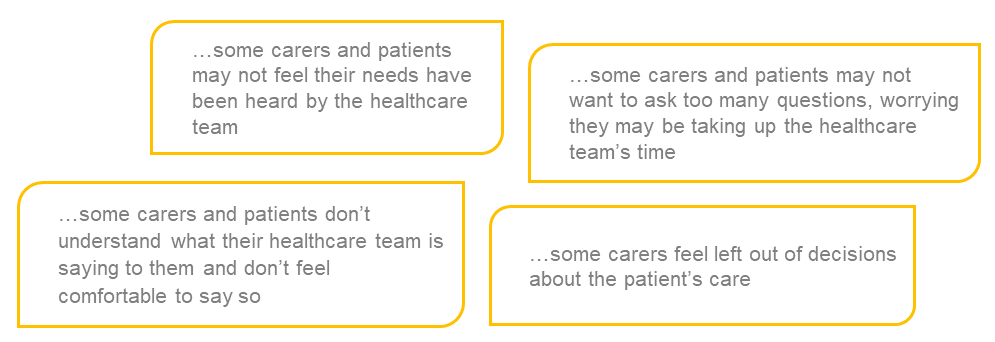
Sometimes it can feel challenging to communicate with the patient’s healthcare team.
This can be because:

It’s important that you feel able to explain your concerns and needs, and the needs of the patient, to the healthcare team. It’s also important to understand what the team are saying to you, to make sure the patient gets the best possible care, and that you feel supported.

‘‘You think the professional’s time is so important but it’s so important that you (the carer) get it right’
– ‘Lisa’, former carer

In this video healthcare professionals discuss ways that carers can make the most of appointments in order to get the best possible care for patients


Speaking to healthcare professionals

Here are some suggestions that can help you get the best out of appointments and conversations with the healthcare team:

  • Give yourself permission to ask questions – as a carer you need to feel sure you have understood what they are telling you, so that you can feel confident when caring for the patient
  • Make a list of any questions you and the patient have and take these with you to appointments
  • You might like to ask the questions that are most important to you first
  • You may have to ask the same question more than once – especially if it is important to you – so that you are sure about the answer
  • You might like to keep a note of what was talked about in appointments
  • If you have been told that the patient is having palliative care, it can help to mention this to make sure that everyone in the healthcare team is aware of what type of support the patient might need

When you’re talking with the healthcare team and you are not sure you understand what has been said, you could say something like:

  • ‘Could you please explain that again as I’m not quite following you? Understanding this will help me support [patient] better’
  • ‘Can I just explain back to you what I think you mean to check that I understand correctly?’
  • ‘I’m not quite following what you are saying, can you just go over that again please?’
  • ‘Can I just check what we have planned? So that it is really clear in our minds?’
  • ‘Is there some more information that we can read or look at to help us with this?’

Sometimes there are questions that you may want to ask that the patient may not want to hear the answer to. You could check any questions you have for the healthcare team with the patient beforehand to find this out.


You need to be aware that sometimes there are things about the patient that the healthcare team can’t talk to you about without the patient’s permission.

Generally healthcare professionals are happy to answer carers’ questions if they are about the carer themselves, or how they can help the patient. For example, a question such as ‘how can I help him/her to eat more?’


Feeling left out of important conversations

Sometimes carers can feel left out of some important conversations about the patient by the healthcare team. Try using the word ‘we’ when speaking with healthcare professionals in appointments. Using the word ‘we’ can help remind everyone that you and the patient are a team – you are in this together.

Remember there are times when the healthcare team can’t speak to carers about the patient, without the patient’s permission.


Click here for a printable version of this page (PDF, 484MB)

Would you like to look at another support topic?

Page last reviewed: 15/12/2025

When someone dies


If the person you are caring for dies, it can be a difficult time particularly if you were very close to them. You may have some strong feelings of grief and loss to cope with. There may also be a number of practical things you need to do at the same time.


Grief and bereavement

Grief and bereavement are words used to describe a range of emotions and physical symptoms that you can experience after someone dies
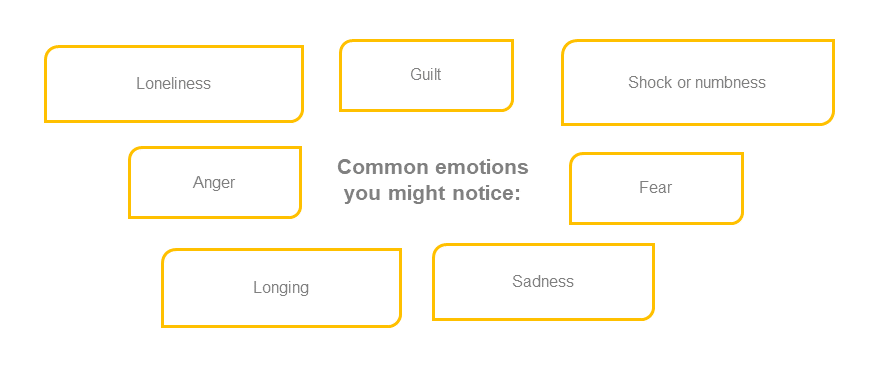
Common changes you might notice in your body:

  • being tearful
  • difficulty sleeping
  • feeling less, or more, hungry and weight loss or gain
  • lack of energy
  • headaches
  • tiredness

It’s normal to feel a wide range of emotions when grieving. You may have different feelings day to day, and even hour to hour. The way we feel grief is different from person to person. There is no wrong or right way to feel. While some carers can feel very strong emotions after a patient dies, others may feel numb, not quite taking in what has happened. They may even feel relief that the patient is no longer suffering. These feelings might last for days, weeks or months. It’s also common for feelings of grief to return around important anniversaries such as the patient’s birthday, the anniversary of their death or special holidays.


Speak with your doctor if you feel unable to cope with daily life and feel that these grief feelings are continuing for a long time.


It is not uncommon for carers to have these feelings even before the patient has died, as you miss the way things used to be before they were unwell, and you prepare for the loss to come.

Some carers have mentioned feeling a ‘double loss’ as, once they are bereaved, they also lose relationships they have built up with professionals involved in the patient’s care.

Feelings of grief can also appear later as well. Grieving for the patient after they have died can be difficult when there are things to organise, leaving little time for carers to experience their feelings. Family and friends may also be visiting at this time which may keep you busy. This may mean that it is only when the practical things are done, and the family and friends have gone, that grief starts to show. Just be prepared for this.

It’s also important to be prepared for the possibility that some people may struggle to know what to say to you and may talk to you a bit less than normal.

‘It may not even hit them [carers] until a couple of days afterwards because you are up until that point, absolutely focused’
– ‘Brian’, former carer for his mother

What you can do to help yourself

Talking about the patient who has died, and what they meant to you, can help you work through grief. Talking to friends and relatives who knew the patient can be a good place to start. Talking with other people who have been bereaved – such as in a support group – or talking with a trained professional can also be very helpful.

‘You can get counselling – why not go and see. It could be something that will help you through it a little sooner or easier’
– ‘Diane’, former carer for her sister


Practical matters

There may be a lot of practical things to organise immediately after the death of the patient. It can help to know ahead what some of these might be, so you can feel a bit more prepared. Not all of these things will need to be arranged by you. If you find you are feeling overwhelmed by the amount of practical things that need to be organised, remember family and friends can help. Some practical things will need to be done by professionals.

Some of the main things that carers or family and friends may need to help organise include:

  • letting the patient’s GP or community nurse know
  • getting a medical certificate for cause of death – several copies if possible
  • registering the death
  • arranging the funeral
  • managing wills and probate
  • arranging the patient’s estate
  • managing benefits – including carer benefits and how they may change
  • reviewing your housing situation
  • cancelling utilities, bank accounts and subscriptions

You can read more about what some of these practical things are and what is involved by visiting Carers UK – Practical Matters.

Some carers struggle to manage these practical things while they are grieving. Using the strategies of prioritising, planning, problem solving and looking after your own health might be useful. Remember that family and friends are likely to be around at this time, and will often want to help – make good use of them.


Planning a funeral ahead of time

Some carers and patients find that planning the funeral together, in advance, can be helpful. It may be reassuring for both the carer and patient to know that the patient’s wishes are being considered, and that things have been organised ahead of time. However, it is important to remember that not all patients and carers want to talk about the funeral together and some patients may prefer to plan their funeral on their own or leave it to others to arrange.


Moving on

After some time, most people notice their grief feelings becoming less intense and they can start to think about the future. They may also be able to start to think about some of the better times they shared with the patient, even while they were ill. While caring for someone with breathlessness can be challenging, some carers have told us that after a few months they have even been able to think about some of the positive things that have come from caring for the patient.

‘We got so close, closer than I thought we’d ever be. You think you’re close to someone, a sister or whatever and we felt we were pretty close but we both said we got so close, we talked about things we’d never talked about’
– ‘Diane’, former carer for her sister

Click here for a printable version of this page (PDF, 499KB)

Would you like to look at another support topic?

Page last reviewed: 15/12/2025
Understanding breathlessness in COPD


COPD, or Chronic Obstructive Pulmonary Disease, is a name for a group of long-term lung conditions including emphysema and chronic bronchitis.

COPD can cause breathlessness by damaging the lungs and airways.

  • Swelling and scarring from this damage can make airways less stretchy, and narrower.
  • Airways can fill with fluids like sputum/phlegm.
  • This makes breathing harder as it’s more difficult to get air out of the lungs.
  • As it’s harder to breathe out, old air gets left in the lungs. This means there is less space for new, fresh air.

That’s why it is important for the patient to focus on breathing out – to move old air out of the lungs and allow new, fresh air to get in.

Remember: not all of these causes of breathlessness will apply to everyone. Speak with your healthcare team if you have any questions about these.

There are other things that can trigger breathlessness and make it feel worse, such as stress or the weather for example. See Stress, panic and breathlessness for more information about these.

For more information about COPD you could visit the Patient.Info website.


Have you tried...?

Understand what breathlessness feels like

If you want to get an idea of what breathlessness feels like for the person you support, you could try doing the following:

  • Take a deep breath in and then breathe out half way. Then breathe in again. Now breathe at that level for a few more breaths.
    OR
  • Take a deep breath in and hold it as long as you can. What does it feel like?

Now imagine you had to go up some stairs breathing like that. This is what breathlessness can feel like.

The video below shows the steps described above so that carers can see what breathlessness might feel like.


What you can do to help the patient

Not everyone with breathlessness wants help from their carer when they are breathless. Some like to be given space to recover their breathing on their own. Others may benefit from the carer saying encouraging, reassuring things and reminding them of the following steps:

  • Pursed lip breathing is a useful way to help them focus on breathing out, creating space for the next breath in.
    Pursed lip breathing is easy to remember as:
    – Smell the rose (breathe in through the nose)
    – Flicker the flame of the candle (gently breathe out through pursed lips to flicker the flame).
  • The video clip below explains why breathing out is so important.
  • Using a handheld fan to cool the face can also help. See Ways to ease breathlessness for more information on using handheld fans.

It’s important to be aware that sometimes breathlessness can look worse to the carer than it feels for the person experiencing it.

  • Ask them to think back to a breathlessness episode and describe it to you. Then ask them to rate on a scale of 0-10 how breathlessness they felt (with 0 being “no breathlessness at all” and 10 being the “worst breathlessness”). Compare this with your experience of that same episode and how you would rate it. It may be that you each rated it differently, which often happens, and this can help you when agreeing what things work to manage breathlessness.

Some carers and the people they support find that agreeing on some signals or hand signs helps to communicate what help they might need when they are out of breath and cannot speak.

Ways to ease breathlessness has a range of other useful ideas and advice too.

In the video below, Specialist Occupational Therapist, Julie Burkin, explains why carers should try to help the person with breathlessness focus on breathing out when feeling breathless

Click here for a printable version of this page (PDF, 348KB)

Would you like to look at another support topic?

Page last reviewed: 15/12/2025

Keeping active


Always get advice from a health care professional who knows the patient’s illness before starting any exercise programme or moving more. They will be able to suggest the best type and amount of exercise or movement for their illness.


Walking around and activity are generally good for the patient – and for you. It can help build up muscle strength and fitness. This can help to boost recovery after infections and reduce tiredness and fatigue. Being active can give more energy and also improve people’s confidence and moral.


Remember that getting the patient to become more active may lead to breathlessness – this can be a good thing though as it helps build up tolerance to feeling breathless and keeps up fitness.


What you can do to help the patient

Encourage the patient to go to an exercise class designed for people with their illness. This is one of the best things you can do.

Try not to do too much for the patient. You want to help them but it’s good for them to do some things for themselves

This might mean doing things differently, or at a slower pace, perhaps stopping every so often to rest and recover. It might also mean using equipment like a walking frame.

Try and do the useful strengthening techniques shown further down this page, together with the patient – starting with 2-3 times a week. These can be helpful when the weather is bad and it is harder to get out.

Remember, you can also support the patient to use the Ways to ease breathlessness while they are keeping active.

“It’s not just saying you must do this more and you must do that. ‘Come on, I’ll show you. I’ll help you and we’ll do it together'” – ‘Karen’, carer for her husband

Watch the video below to learn about ways carers and patients with breathlessness keep active. Sophie Howson, former community matron and district nurse, also explains the importance of staying active when living with breathlessness

Have you tried...?

Useful strengthening techniques
The patient can do these at home, sitting in a chair. You might want to do them together with the patient.

Try and start by working from the level where the patient is now. Then gradually build up to do three sets of 10 for each exercise as they get easier.

Think legs, not lungs
Strengthening the patient’s legs will help their lungs – try these:
• Standing up from sitting in a chair
• Gentle marching whilst sitting in chair
• Walking with a pedometer – try to build up the number of steps

Arm strengthening
• Arm curls using small weights (you could use small bottles of water)
• Arm punches
• Upright rows (hold small weights with palms facing downwards and elbows out to the side, raise arms up to shoulders and down again).

Watch the video below to see how to do these exercises.

Watch this short video to see the strengthening techniques demonstrated – strengthening legs and arms will help to keep the patient active

Click here for a printable version of this page (PDF, 700KB)

Would you like to look at another support topic?

Page last reviewed: 15/12/2025

Living a fulfilling life


It’s possible for you and the patient to live a fulfilling life with breathlessness.

You and the patient can support each other to do the things you enjoy. This might be things you do together, as well as things you do separately.

There are lots of activities you can do together, and some might even help the patient’s breathlessness.


Some ideas are:

  • Tai Chi or yoga classes
  • Singing in a choir you can find information about singing groups on the British Lung Foundation website
  • Watching sports – cheering can help breathing!
  • Gentle walking groups – many GP surgeries and local communities offer these

Have you tried...?

The 5 Ps of living a fulfilling life

Using the 5 Ps can help you plan how and when to do activities. These may seem like common sense, but they can be quite difficult when living with breathlessness:

  • Prioritise – prioritise energy-giving activities and things that are most important
  • Plan – plan time flexibly for activities for the day and for the week
  • Pace – pace activity by balancing activity with rest and avoid the boom/bust trap
  • Problem solve – work together to solve problems
  • Permission – allow the patient to do things in a way that works for them. Also give yourself permission, as a carer, to take time for yourself. It’s often not what you do but how you do it that can make all the difference.

In the video below, hear from Specialist Occupational Therapist, Julie Burkin, how using the five Ps can help you to keeping doing meaningful activities with breathlessness

What you can do to help the patient

  • Find a time to sit down together to plan some things you can do together – at home and away from home
  • Choose something you both enjoy and perhaps something new to try
  • Now use the 5 Ps on this page to help you plan how and when you will do these activities
  • Remember, you can also use the Ways to ease breathlessness wherever you are, including when you are out and about

In the video below carers and patients share ideas for ways they live a fulfilling life with breathlessness

Click here for a printable version of this page (PDF, 423KB)

Would you like to look at another support topic?

Page last reviewed: 15/12/2025

What to expect in the future


Please note: the information in this topic is provided to help prepare you and the patient if things get worse. Some people can find reading and talking about this type of information upsetting. 


Thinking and talking about the future can be difficult – both for you and for the patient. It can feel hard to know when and how to start.

But thinking and talking about the future is important – it may help you and the patient be better prepared for what might happen.

‘Some people won’t want to talk about it … I can understand, it’s very hard… but there should be some encouragement to talk about it ‘cause it does make life simpler’
‘Jim’, former carer to his wife

Within this topic you will find information that carers, patients and healthcare professionals have told us would be helpful for carers and patients to know and think about.


Information in this topic includes:

Some carers may find it helpful to look at this topic with the patient – others may prefer to look on their own – do whatever is best for you.


I’m really torn because people tell you to live in the moment and not to plan but then you also want to know a little bit. You may be hanging on too long. We couldn’t have talked about this when Richard was ill. You have to talk when you can, when you are well’
‘Alice’, carer for her husband
 

Would you like to look at another support topic?

Page last reviewed: 15/12/2025